Food Quality vs. Calorie Counting: Which Lever to Pull First
Two people eat 2,000 calories a day. One eats predominantly whole foods — meat, fish, eggs, vegetables, fruit, nuts, and some quality carbohydrate. The other eats predominantly processed food — cereal, packaged snacks, ready meals, low-fat yoghurts, and white bread — engineered to hit the same caloric total. Their metabolic outcomes will not be the same. Their hormonal environments will not be the same. Their satiety, their energy, their body composition, and their long-term health markers will diverge substantially. Calories matter. But they are not the whole story, and for most people who are trying to improve their health and body composition through food, they are not the first lever to pull.
Food quality affects the hormonal environment in which calories are metabolised, and this is the mechanism that resolves the apparent contradiction between calorie-based models and whole-food advocates. A calorie of ultra-processed food is not metabolically equivalent to a calorie of salmon. The processed food triggers a sharper insulin response, produces a weaker satiety signal, stimulates ghrelin less effectively, and delivers fewer micronutrients per calorie consumed. The result is a metabolic environment that drives biological hunger, promotes fat storage, and impairs recovery. The salmon does the opposite. Same caloric input, different downstream consequence.
Protein leverage theory is particularly illuminating here. Research by David Raubenheimer and Stephen Simpson proposes that the body has a fixed protein target — a level of protein intake that the appetite system is seeking to satisfy. When protein density in the diet is low, as it is in most ultra-processed food, the appetite drive continues until that protein target is met. This means that people eating low-protein, processed diets consume more total calories not because of a lack of discipline but because their appetite system is correctly signalling that the protein target has not been hit. Shift the diet toward higher protein density through whole foods and total calorie intake often falls spontaneously — without counting, without restriction, without hunger.
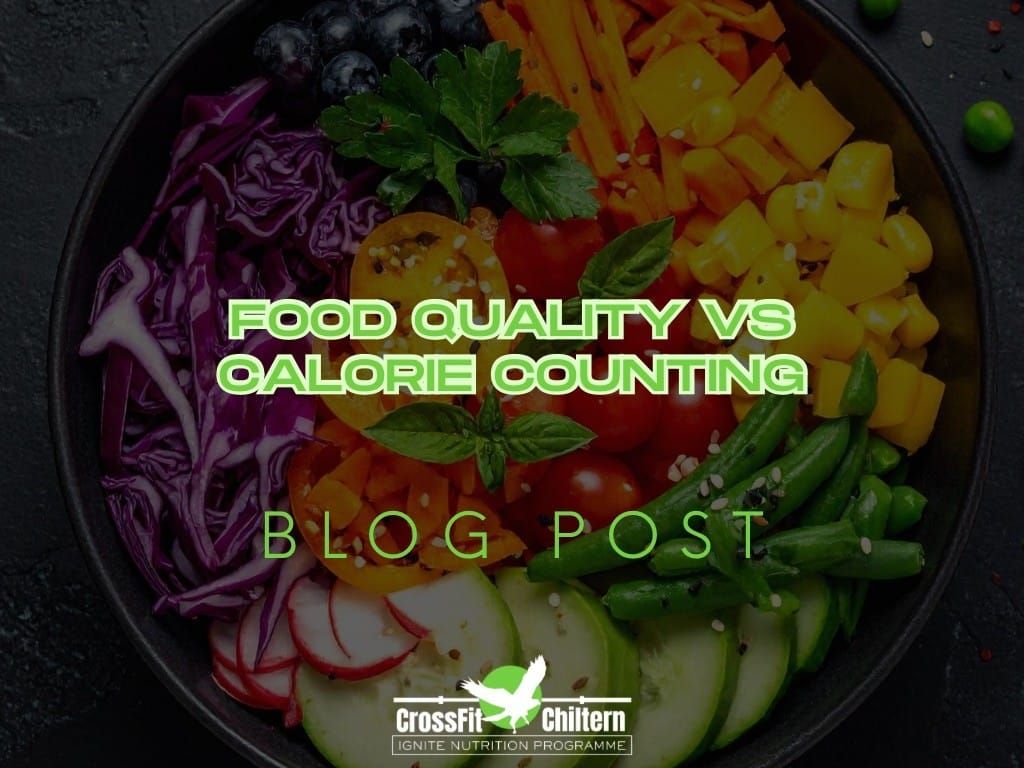
For the majority of people who come to us having spent years in a complicated relationship with food — tracking, restricting, cycling through diets — the immediate introduction of calorie counting adds cognitive load without addressing the underlying dietary pattern. The more productive starting point is almost always food quality. Clear the processed food from the kitchen. Prioritise protein at every meal. Eat vegetables in volume. Add quality carbohydrate around training. Once this pattern is established and the hormonal environment is functioning correctly, calorie awareness can be a useful refinement — but it is a refinement, not a foundation.
Calorie counting does have its place. For athletes with specific body composition goals who are already eating a high-quality diet and want to fine-tune their intake, tracking can provide useful data. For someone who genuinely cannot understand why their weight is not moving despite what feels like good eating, a brief period of logging can identify the invisible calories — the olive oil, the handful of nuts, the two glasses of wine — that are creating a surplus. But these are specific applications, not universal first steps.
The lever sequence is: food quality first, protein adequacy second, total calorie awareness third. In that order, for most people, most of the time.
Our Ignite Nutrition Programme — led by Dr. Amy George, GP, CrossFit Level 1 coach and HSN Nutrition coach — covers all six pillars in a structured, supported environment. Book your Discovery Call at crossfitchiltern.com.