Why Lunges Leave You Sore for Three Days
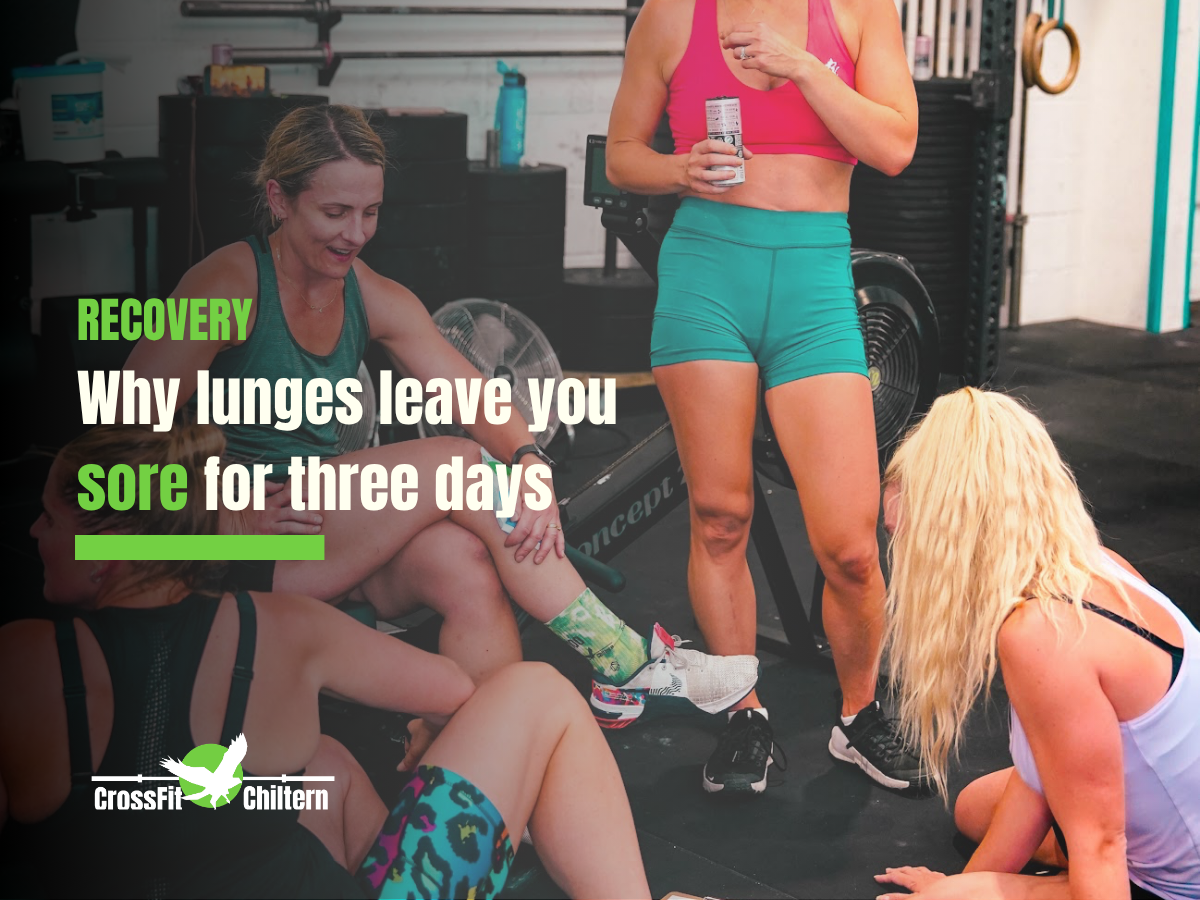
Wednesday's session had sixty walking lunges in it. Thursday you feel fine. Friday you're going down the stairs at Amersham station sideways, hanging on to the handrail.
Wednesday's session had sixty walking lunges in it. Thursday you feel fine. Friday you're going down the stairs at Amersham station sideways, hanging on to the handrail.
Lunges do this more reliably than any other movement we programme, and the reason changes what you do about it.
Muscle damage comes overwhelmingly from the eccentric (lowering) phase, not the concentric (lifting) phase. When a muscle produces force while it's being stretched — the front leg controlling your descent into the lunge — fewer fibres share the load and the mechanical stress on each one is far higher. Do that at a long muscle length, deep in the movement, and you get more disruption still. A lunge hits every one of those conditions at once: a deep range, a slow controlled descent (you can't drop fast without smashing your knee into the floor and this isn't advised!), and one leg carrying what two legs normally share. Each rep, that front quad is taking roughly double the load per unit of muscle that a two-legged squat gives it.
The soreness itself is the inflammatory response that follows the damage, which is why it arrives late — building through the first 24 hours, peaking somewhere between 24 and 72. Hence Friday.
Then the repeated bout effect, which is one of the most robust findings in exercise science. Do the same movement again within a few weeks and the second dose produces a fraction of the soreness. Not because you've recovered better, but because the muscle has reorganised to tolerate it. That protection lasts weeks. Often we squat more than double the times we lunge so we don't have as much exposure.
So the answer to lunges is more lunges. If sixty in a workout wrecked you, do 2 sets of 10 per leg, bodyweight, twice this week. Next time the session has lunges in it, you'll barely notice.
Lunges aren't alone in this. Step-downs, Bulgarian split squats, running downhill, GHD sit-ups and the lowering half of any slow tempo lift all do the same job. If a session has any of those in volume and you haven't done them for months, expect Friday.
For the three days you're in pain, move. Walking, an easy bike, a light row. Passive stretching has been tested for this repeatedly and doesn't reduce soreness, so stretch if you enjoy it and don't expect it to work. Train the rest of your body normally. Being sedentary is the worst choice!
One thing that isn't DOMS: sharp pain, pain on one side only, or pain in a joint rather than the belly of the muscle. That's a physio conversation.
Coming back after time off and worried about exactly this? That's most of the people we speak to. Free, no-obligation 15-minute chat with Jeremy or Beth at crossfitchiltern.com.