Why We Score
Every workout here has a score. A time, a number of reps, a load — something goes on the board at the front and something goes in the app. For a nervous beginner that looks like a leaderboard, and that can be somewhat off-putting.
Every workout here has a score. A time, a number of reps, a load — something goes on the board at the front and something goes in the app. For a nervous beginner that looks like a leaderboard, and that can be somewhat off-putting.
A score exists so that an hour you did in September can be compared to the same hour in March. Without one you're left judging your own fitness by how you felt, which is the least reliable instrument you own — it moves with your sleep, your week and last night's session.
Work capacity equals force multiplied by distance, divided by time. This is the best measure of fitness. If you do 5 back squats 10kg heavier in the same amount of time, you got fitter. If you ran 5k faster you moved your bodyweight faster. If you do a benchmark workout faster and with a more challenging skill, you got fitter. This is the best measure of fitness you have. Better than anything your Bloop band or Bora Ring can tell you.
Which only works if the entry means something. So write the scale next to the score. Not "12:40" — "12:40, 30kg, banded pull-ups." Six months from now that line tells you whether 12:50 on a heavier bar was better or worse, and without it you're comparing two numbers that measured different workouts. Half the people who tell me they've stopped improving have a year of scores with no conditions attached. I can't help with that.
So the score is about you. But the board isn't only about you, and this is the part people don't expect.
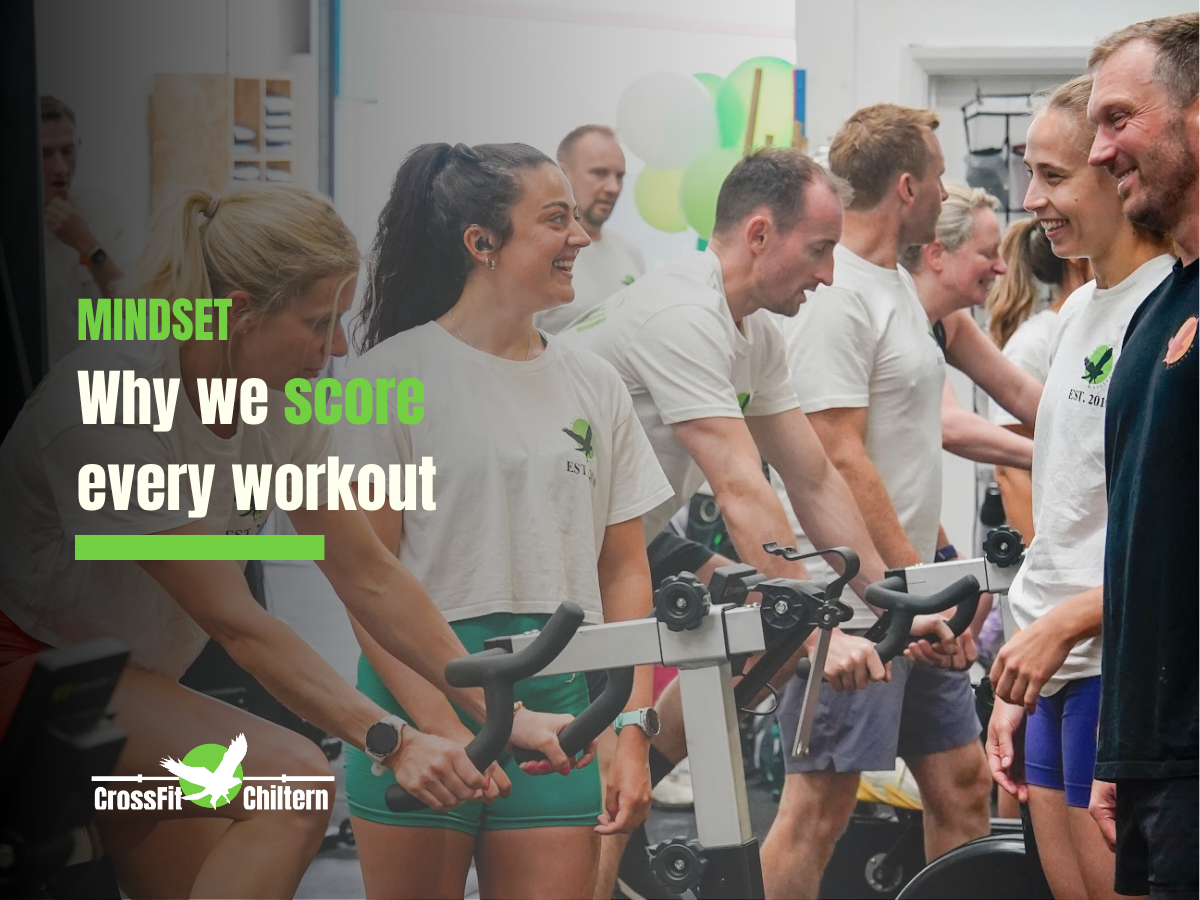
Remember also effort in company is measurably higher than effort alone. You don't stop at rep eight when the person next to you is on rep ten. Neither of you is racing directly — but it's definitely motivating with someone there. It works whether they're fitter than you or nowhere near because we do a fantastic job scaling so the fit 30 year old has to work hard to keep up with the 60 year old newbie.
What everyone respects is work rate, not output. The member who scaled, held their standard and finished with nothing left gets more of a nod than the fastest time on the board. Everybody who has been here a while can tell the difference, and the fastest time is often not the best session, it often just indicates that next time that athlete can scale less!
Reading a board that way is a skill you pick up in a couple of months, and it's when the board stops being intimidating and starts being useful. You can look down it and find the person on the same scale as you, three months ahead, and see what's realistic this year.
Nobody is auditing the bottom of it. The fittest person in the class isn't thinking about your time; they're annoyed about their own, because they wanted 8:40 and got 9:02.
Write the load and the scale next to your time today.
If the board is the bit putting you off, say so on the phone — you won't be the first, and it won't be the reason we suggest anything different. Free, no-obligation 15 minutes with Jeremy or Beth at crossfitchiltern.com.