Training, Recovery and Food for Women: What We Know and What We Don't
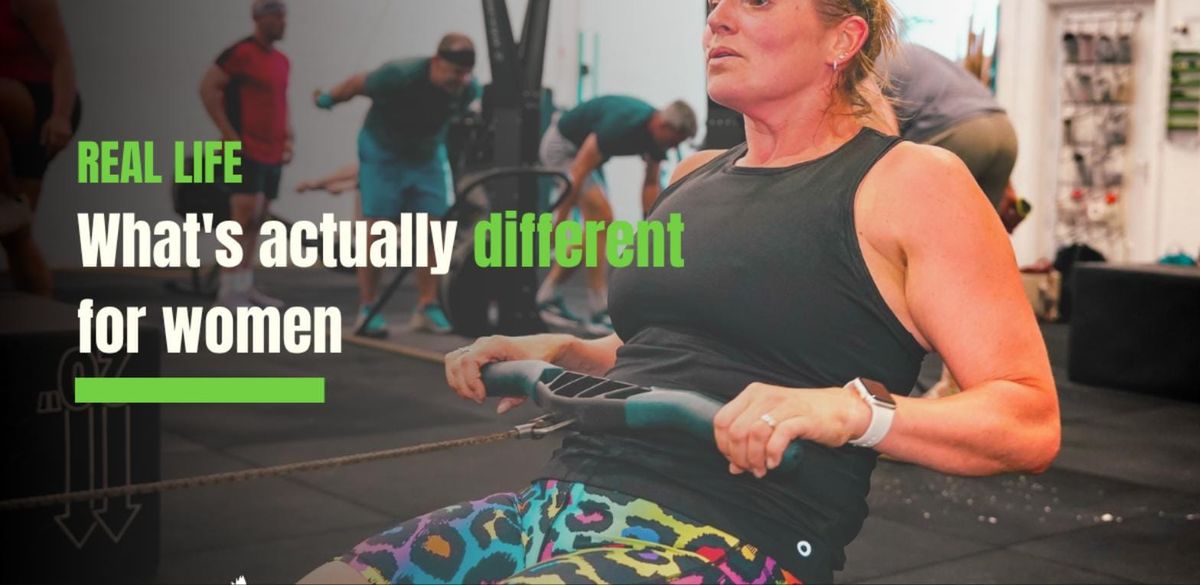
Lisa asked how training, recovery and nutrition differ for women. The answer starts with an admission: we don't know as much as we should. For decades the studies were run on young men, because a menstrual cycle is an inconvenient variable. So a lot of what gets confidently repeated about women's training is extrapolated from men, or built on fifteen participants and a headline. Anyone telling you they've got it all worked out is selling something.
What we can say, and where it gets soft:
What's the same — and it's most of it. How muscle is built. The response to lifting heavy. Progressive overload. The protein requirement per kilo. The value of sleep. The fact that a set has to get hard before it counts. Women get strong the same way men do, and the idea that they need a separate, careful, lighter category of training is nonsense — nonsense that's kept a generation of women on the cross-trainer instead of in the free weights.
What is different. Women carry less muscle in absolute terms and are usually further from their protein target, because portions scale down with body size and the per-kilo requirement doesn't. 1.6 to 2.2 grams per kilo still applies. A 65kg woman needs 105 to 143 grams a day. Very few are close.
Bone matters more, sooner. The menopause years bring an acceleration in bone loss, and loading the skeleton — heavy, compressive, barbell work — is the most effective non-medical thing there is for it. This is why I want women lifting heavy in their forties, not walking on a treadmill.
Iron matters more too, particularly with heavy periods. Low iron shows up as fatigue no amount of sleep fixes — if your engine falls off a cliff and you can't explain it, that's a blood test with your GP, not a training problem.
The cycle: you may feel stronger in the first half and flatter in the second. Something to be aware of, but the evidence doesn't support elaborate cycle-based programming — the effects are small next to simply training consistently.
Perimenopause and menopause: sleep gets worse, recovery takes longer, body composition shifts, and none of it is a failure of effort. The same session may need more recovery around it, and strength work becomes more important, not less. If symptoms are affecting your life, see your GP. What I can tell you is what I see in this building — the women who keep lifting through it hold on to their strength, and the ones who back off don't get it back easily.
Eat more protein than you think, lift heavier than you've been told to, and log how you feel across the month.
If the thought of walking into a gym makes you wince, this is exactly who we built the place for. Book a free, no-obligation 15-minute chat with Jeremy or Beth at crossfitchiltern.com — no hard sell, and most of us hadn't trained in years when we started. We'll build a plan around your life, not a generic template.