Why We Retest
Ask someone whether they're fitter than they were in March and watch what happens. They think about how they feel. And how they feel is mostly a function of how they slept, what's happening at work, and whether last night's session went well. Or often they'll look at the number o

Ask someone whether they're fitter than they were in March and watch what happens. They think about how they feel. And how they feel is mostly a function of how they slept, what's happening at work, and whether last night's session went well. Or often they'll look at the number on the scales.
These are not reliable measures of true fitness.
A benchmark fixes that. The same workout, the same movement standards, done again months later. Whatever else has changed, the workout hasn't. Four minutes faster with the same load, 10 seconds faster with a heavier load or a more advanced gymnastic movement — that is an improvement in work capacity.
This is why we test five benchmark workouts and the main lifts during Ignite, in the five one-to-one hours that run alongside your classes from the first week, and retest them across the following twelve months. Twelve months, not six weeks. Fitness doesn't improve in a straight line — it moves in steps with long flat bits, and a six-week window can catch you in a flat bit.
What counts as a good result is worth calibrating too. In a first year, taking two or three minutes off a ten-minute benchmark is normal. After three or four years, thirty seconds is a serious improvement, and holding the same time at forty-five that you set at forty is a win. Compare against your own number, at your own age.
Two rules make a retest worth doing.
Record the conditions, not just the score. Load, scale, time of day, how you slept. "12:40" tells you very little in six months. "12:40, 30kg, banded pull-ups, 6pm class" — or "13:10, after 3 nights of the little one keeping me up all night" — tells you exactly what to compare against, and helps when comparing the data WodBoard holds. This is why we want you to use the app. Data helps!
And leave it alone in between. A benchmark you do every three weeks stops being a measurement and becomes just another workout. Three to six months is about right.
If a retest comes back worse, read the conditions before you read the number. An evening retest against a morning original, a heavier scale, a week of five hours' sleep — any of those explains it. A decline you can trust shows up across two or three tests.
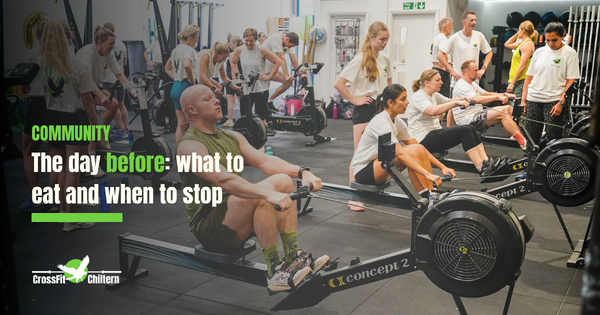
If you want a number today, this takes ten minutes and needs no coaching: 500 metres on the rower, two minutes rest, 500 metres again. Write down both splits and the date. Do it again in January.
We see so many improvements here at the box and the benefit for me as a programmer is it also allows me to see opportunities to make changes to improve the fitness of our members.
Get started today with a free, no-obligation 15-minute chat with Jeremy or Beth at crossfitchiltern.com.