Mobility Isn't Something You Do Afterwards
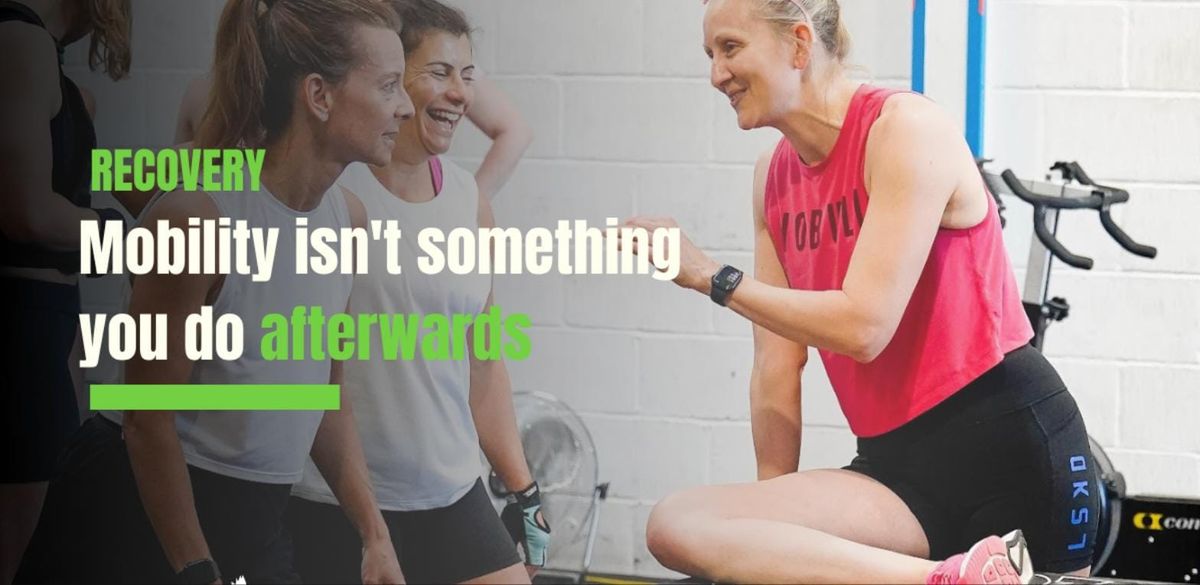
Lauren asked me what she should actually be doing after a session — stretching, foam rolling, all of it — and how to catch up if she's neglected it for a couple of years.
My answer surprised her, so I'll give you the same one. Stop planning the hour of stretching. It isn't coming. You know it isn't coming, I know it isn't coming, and the guilt about it is doing more damage than the missing hour.
Your mobility work is already in the session. You're just not using it.
When you stretch a muscle passively — sitting on the floor reaching for your toes — you're mostly telling your nervous system that it's safe to be in that position. The range you gain is real, but it's range you can't necessarily control. Passive range you can't produce force in is a party trick. It doesn't hold up in a session.
When you take a joint through a full range under load, you're telling the nervous system two things at once: it's safe here, and you're strong here.
You are already doing loaded reps. Three or four times a week. The question is whether you're using them.
What to do, and none of it adds a session to your week.
Use your full range on your warm-up sets. Every single one. The empty-bar sets, the light sets, the ones you're tempted to rush through — that's where you go all the way down, all the way overhead, all the way through. The warm-up sets are your mobility session and they're free.
Slow the eccentric. Three seconds down on a squat, a press, a pull-up. The controlled descent is where range gets built, and it costs you nothing but ego.
Add a pause where you're tight. If your squat bottom is the problem, do three sets of five goblet squats with a two-second pause at the bottom, twice a week. That is a complete mobility programme for your hips and it takes four minutes.
For overhead, load it. Hold an empty barbell locked out overhead and walk twenty metres. Twice. Shoulders that can't get overhead usually can't get overhead and stay strong — carrying fixes both at once.
The foam roller has a job, but it's a very small one. Five minutes, before you train, on whatever's sore. It's a warm-up tool that makes the first few reps feel better. It is not a treatment and it doesn't change the tissue. Use it and move on.
If you've genuinely let it go for two years, the catch-up plan is not an hour on a Sunday. It's ten minutes, three times a week, in loaded positions — which, if you've been reading properly, means it's mostly just the front half of the sessions you're already attending.
One caveat. Tight is not the same as painful. If a position hurts rather than pulls, don't drive into it and don't foam roll it into submission. See a physio. Sometimes tightness is the body protecting something, and stretching it harder is exactly the wrong treatment.
If the thought of walking into a gym makes you wince, this is exactly who we built the place for. Book a free, no-obligation 15-minute chat with Jeremy or Beth at crossfitchiltern.com — no hard sell, and most of us hadn't trained in years when we started. We'll build a plan around your life, not a generic template.